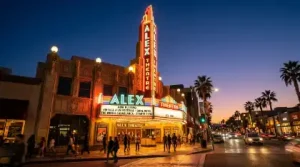
Standing tall beneath the Southern California sky, the 100-foot neon tower of the Alex Theatre has served as a beacon of culture, entertainment, and architectural beauty in downtown Glendale for over a century.
In the heart of downtown Glendale, California, amidst modern high-rises and bustling commercial avenues, stands a shimmering monument to entertainment history: The Alex Theatre. Since opening its doors in the roaring twenties, this legendary venue has captivated generations of theatergoers, film enthusiasts, and architecture lovers.
Originally built as a grand movie palace and vaudeville house, the Alex Theatre represents a bygone era of theatrical magnificence. From its exotic architectural motifs to its iconic Art Deco marquee tower, exploring the Alex Theatre offers a fascinating glimpse into the evolution of American entertainment and civic historic preservation.
The Birth of a Golden Age Landmark
The story of the Alex Theatre begins in the early 1920s when Glendale was rapidly expanding from an agricultural community into a thriving suburban center. Formally opening on September 4, 1925, as the Alexander Theatre, the venue was constructed by West Coast Theatres and named in honor of Alexander Langley, the son of local promoter C.L. Langley.
Designed by the renowned architectural firm Meyer & Holler—the visionary minds behind Hollywood’s famous Grauman’s Chinese and Egyptian Theatres—the Alex was envisioned as a lavish escape from the everyday world. The architecture seamlessly blended atmospheric Greek, Egyptian, and Spanish Revival elements, immersing patrons in a opulent theatrical fantasy the moment they stepped inside.
During its initial decades, the theater accommodated over 2,000 spectators at a time. It featured a fully equipped stage for live vaudeville performances, an orchestra pit, and an elaborate organ designed to accompany silent films, establishing itself as the cultural epicenter of Glendale.
Architectural Evolution: The Iconic 1940s Marquee Tower
While the interior of the Alex Theatre captured the fantasy of the 1920s, its exterior underwent a dramatic transformation in 1940 that defined its signature visual identity forever.
Architect S. Charles Lee, a pioneer of Art Deco and Streamline Moderne theater design, was hired to modernize the venue’s facade. Lee constructed a magnificent 100-foot-tall neon marquee tower topped with a glowing “starburst” motif. This striking spire, combined with a sweeping neon canopy, transformed the theater into an unmissable landmark along Brand Boulevard.
The neon-lit marquee became more than just advertising space; it became a symbol of Glendale’s vibrant nightlife. To this day, the tower remains one of the finest surviving examples of Streamline Moderne commercial architecture in Los Angeles County.
Hollywood Previews and Theatrical Legacy
Throughout the Golden Age of Hollywood, the Alex Theatre played a direct role in film history. Due to its proximity to major studio lots in Burbank and Hollywood, major studios frequently selected the Alex as a primary location for high-profile test screenings and previews.
Studio executives, directors, and stars—including figures like Bing Crosby, Elizabeth Taylor, and Cary Grant—frequented the theater to gauge audience reaction before releasing major motion pictures to nationwide audiences. Classic cinematic masterpieces, including National Velvet and Meet Me in St. Louis, screened their early cuts inside the Alex’s auditorium.
A Journey Through Restoration and Revival
Like many grand movie palaces across the United States, the Alex Theatre faced severe challenges during the late 20th century. The rise of suburban multiplexes and home television led to declining attendance during the 1970s and 1980s, leaving the building vulnerable to neglect and potential demolition.
Recognizing the immense cultural and historical value of the structure, the Glendale Redevelopment Agency acquired the building in 1991. Working closely with local advocacy groups, including The Glendale Historical Society, the city launched a comprehensive multi-million dollar restoration campaign.
Restoration artists meticulously preserved the vintage plasterwork, restored original murals, updated technical lighting and sound systems, and revived the famous 100-foot neon spire. Reopening in December 1993 as a premier performing arts center, the Alex Theatre reclaimed its rightful place as the crown jewel of Glendale’s arts district.
The Alex Theatre Today: A Living Cultural Center
Today, the Alex Theatre is a vibrant, multi-disciplinary performing arts venue hosting over 100 events every year. Rather than operating merely as a static historical monument, it continues to serve as an active center for live entertainment, community gatherings, and cultural celebrations.
The venue regularly hosts:
- Live Music & Concerts: Musical performances ranging from classical symphony orchestras to international world music acts.
- Film Screenings & Festivals: Classic silent movie revivals featuring live organ accompaniment, independent film showcases, and special anniversaries.
- Dance & Ballet Performances: World-class dance troupes and local performing arts academies utilizing the theater’s full-sized stage.
- Civic & Cultural Events: Local community programs, educational lectures, and private celebrations.
Visiting the Historic Alex Theatre
Located at 216 North Brand Boulevard, the Alex Theatre is positioned in the heart of downtown Glendale, within walking distance of renowned dining, shopping, and cultural destinations.
Whether you are attending a live orchestral performance, viewing a classic film revival beneath historic ceilings, or simply taking in the breathtaking glow of its 100-foot neon tower on an evening stroll, visiting the Alex Theatre is an essential Glendale experience that bridge the past with the present.